{{ 'fb_in_app_browser_popup.desc' | translate }} {{ 'fb_in_app_browser_popup.copy_link' | translate }}
{{ 'in_app_browser_popup.desc' | translate }}
{{word('consent_desc')}} {{word('read_more')}}
{{setting.description}}
{{ childProduct.title_translations | translateModel }}
{{ getChildVariationShorthand(childProduct.child_variation) }}
{{ getSelectedItemDetail(selectedChildProduct, item).childProductName }} x {{ selectedChildProduct.quantity || 1 }}
{{ getSelectedItemDetail(selectedChildProduct, item).childVariationName }}
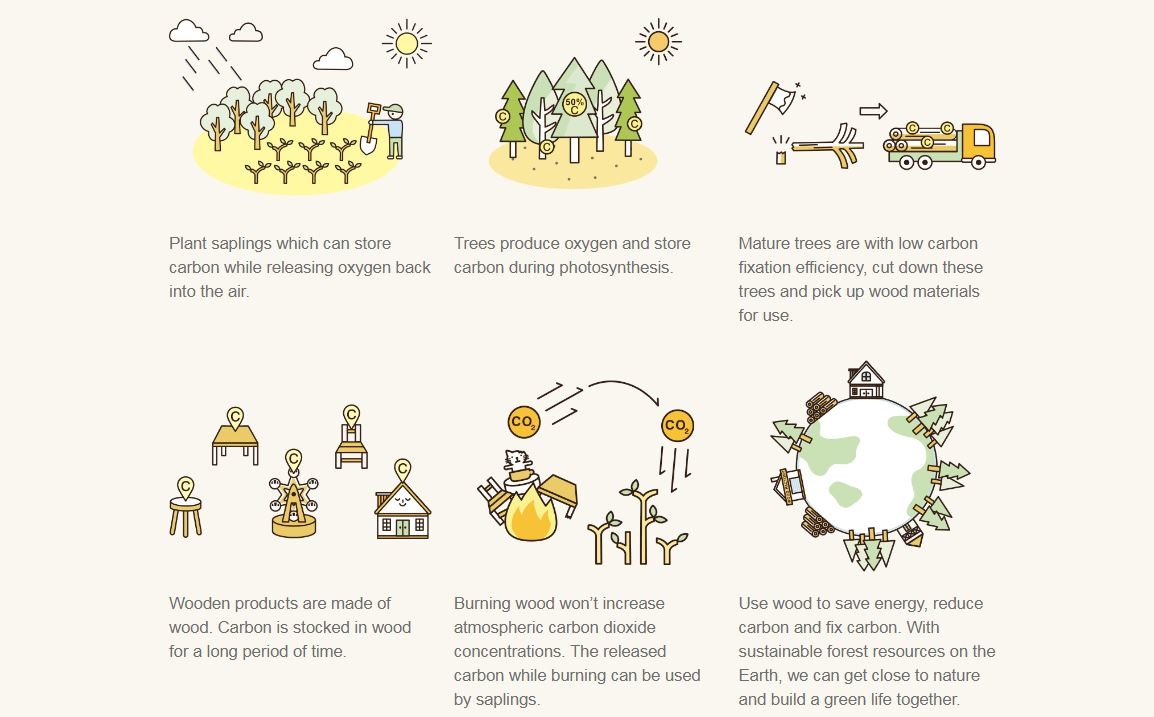
Through the ages, people and forests have been inseparable from each other. Apart from conserving soil and water, breaking wind, purifying air, regulating climate, and nourishing species, forestation has become a known effective method to reduce greenhouse gases (GHGs). While forests are a sustainable green resource, using more wooden products in daily life can promote economic development.
Based on the sustainable forest policy, forestation takes place, mature wood with weakened carbon fixation effect is logged, and new seedlings of trees with better carbon capture and storage (CCS) and higher oxygen release performance are grown. Strategic forestation and logging enable the continuation and sustainable use of wood resources. Logging is never the opposite of environmental protection, and strategic logging aims to let the remaining trees grow in a better condition. In addition, the wood being logged will become an important resource for economic development and in our daily life. Therefore, maintaining a balanced cycle of forests through the effective use of wood is the concept of sustainable forest.
Using wooden products does not mean paying more.
Instead, it is a more economical option. The rise of wood demand can promote local forestry development to demonstrate the green power of forests. We are benefited by forests and learn how to enrich life and spirit from the diversity of tree and wood uses.
As an NHLA member, Wooderful life uses legally planted wood with a certificate of origin from sustainable forests in Europe, the USA, Canada, and New Zealand. We do not damage forests for commercial logging. Instead, effective logging from commercial forests brings sustainable forest operations and achieves environmental protection. By implementing a high-yield-rate production process, we effectively reduce wood wastage. In the future, we will enforce green production to realize our insistence on wood.